

HISTORIC PATTERNS OF EXCLUSION
The American ideals of life, liberty, and the pursuit of happiness were conveyed in the 1776 Declaration of Independence, but despite these idyllic words, immigrants have faced xenophobia, racism, and resistance. The immigrant experience in America has been defined by a pattern of hostile anti-immigration sentiment in mass media and U.S. policies that exclude, deport, and incarcerate immigrants from non-European countries.
The disparate treatment by the US government can be seen as early as the eighteenth century, with the 1790 Naturalization Act that only allowed white immigrants to attain citizenship. The arrival of Chinese immigrants in the US to work on the railroad, mines, and farms in the mid-1800s created a fear that the Chinese were taking white Americans’ jobs.
An 1871 Harper’s Weekly cartoon depicts a Chinese immigrant hiding from an armed, angry white mob below various anti-Chinese signs, one of which states that “Chinese paganism has, by its fruit, a practical immortality fouler by far than that known among any European or Christian people.” The language represented in the cartoon exemplifies the public sentiment of the time that the Chinese were “fouler” than any European or Christian. The US government’s bias against a wave of Chinese immigrants culminated in the Chinese Exclusion Act of 1882.
American animosity towards non-European immigrants only grew during the economic downturn of the Great Depression in the 1930s and was directed at Mexicans and Mexican American citizens. The newspapers called Mexican and Mexican Americans, many of whom were US citizens, “alien hordes” and blared headlines that read, “Unified Efforts to Oust Aliens Being Evolved.” The US government’s limitations on non-European immigration escalated into mass deportations of an estimated one million Mexican and Mexican American citizens from 1929 to 1936, violating the constitutional rights of the Mexican American citizens.
In the following decade, during World War II, the American public’s hatred of the Japanese contrasted with its more favorable impressions of Germans, despite America being at war with Japan and Germany. American newspapers presented all Japanese and Japanese Americans as the enemy, while they distinguished Germans from Nazis. President Roosevelt’s Executive Order 9066 forced all of the roughly 120,000 people of Japanese descent living in the US, about 90,000 of whom were US citizens, into incarceration camps in 1942.
CURRENT EXCLUSION
This is not an issue of the past; the continued bias for European immigrants versus non-European immigrants is well-documented in newspapers and public opinion polls. In a 2022 Washington Post survey, American participants favored Ukrainian refugees over Afghan refugees by 14 percentage points. More participants thought that Afghan—not Ukrainian—refugees would “increase the likelihood of terrorism in our country,” even though “between 1980 and 2016, refugees committed no fatal terrorist attacks in the United States.”
In a current revival of animosity towards non-European immigrants, Republican Convention attendees gave a rousing round of applause when then-Presidential Candidate Donald Trump stated at the Republican National Convention in 2024 that America’s “immigration crisis” was spreading “misery, crime, poverty, disease and destruction to communities all across our land” and that America’s cities are being “flooded” by the “greatest invasion in history” of murderous maniacs from “every corner of the earth, not just from South America, but from Africa, Asia, [and the] Middle East.” The American public’s and mass media’s historic and current hateful sentiment toward non-European immigrants and preference for European immigrants has directly translated into government laws and policies with the same bias.
CURRENT TARGETING OF LATINOS
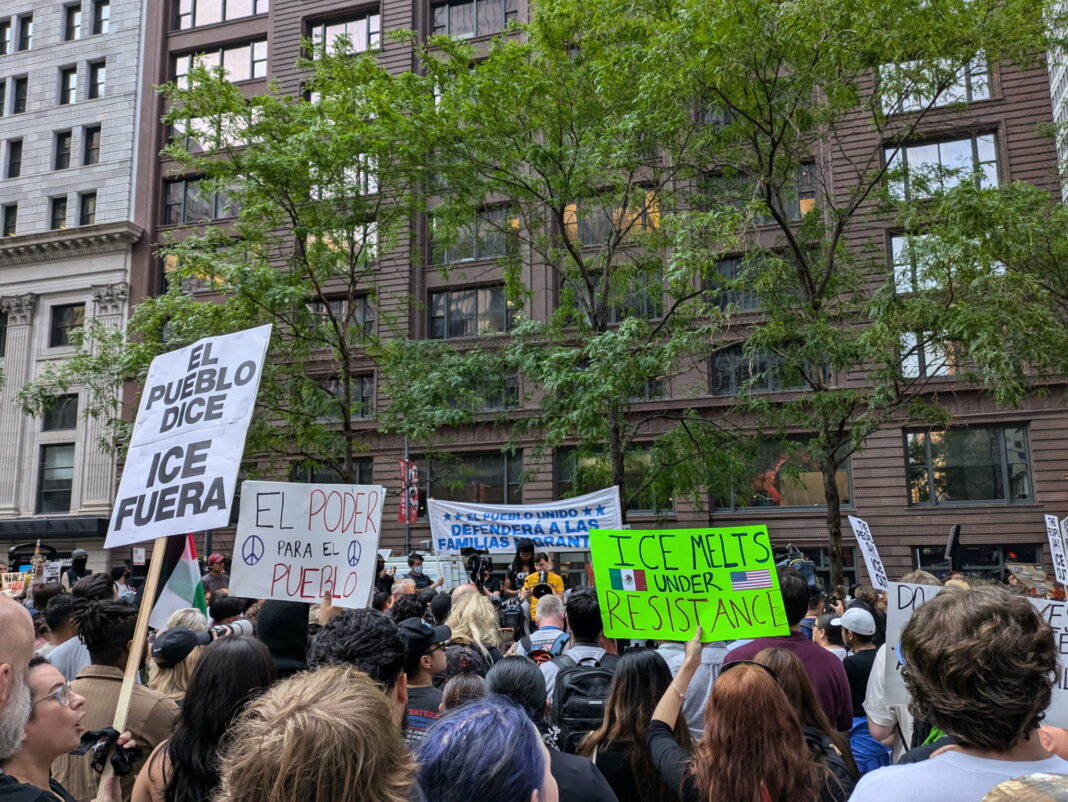
In a repeat of the 1930s, the US government is currently promising sweeping mass deportations of Latin Americans, invoking the obscure 1798 Alien Enemies Act. President Trump purportedly made clear in a private Oval Office conversation that his “racial hierarchy… [places] Europe, particularly Nordic Europe, at the top, Asia in the middle, and the nations of Africa, the Caribbean and Latin America at the bottom,” and promised mass deportations of as many as 20 million.
The most notable of the government’s mass deportation campaign involves Kilmar Ábrego García. Despite living in the US legally without any criminal charges or convictions, in March 2025, Ábrego García was illegally deported to CECOT, the Salvadorian Terrorism Confinement Center, notorious for its inhumane conditions. While he was returned to the US in June, Ábrego García was imprisoned in Tennessee but detained by ICE after his release. Wrongfully labeled as an MS-13 Gang member by the Trump administration, Ábrego García’s ongoing legal battles demonstrate the government’s continued targeted and unconstitutional deportations of Latinos.
Within the last month, the Supreme Court overturned the case Vasquez Perdomo v. Noem, signaling yet another instance of the US government’s recent targeting of Latinos.
The Supreme Court’s order permits ICE and Border Patrol agents in Los Angeles to question and detain people based on their racial appearance and other racially-motivated factors, such as speaking Spanish or working at a low-income job. According to Supreme Court Justice Sotomayor,
“We should not have to live in a country where the Government can seize anyone who looks Latino, speaks Spanish, and appears to work a low-wage job… I dissent.”

Tribuno del Pueblo brings you articles written by individuals or organizations, along with our own reporting. Bylined articles reflect the views of the authors. Unsigned articles reflect the views of the editorial board. Please credit the source when sharing: tribunodelpueblo.org. We’re all volunteers, no paid staff. Please donate at http://tribunodelpueblo.org to keep bringing you the voices of the movement because no human being is illegal.


Very good analysis.
Thank you for reminding us of the history of repression and the resilience of our Mexican and Latino brothers and sisters. We must resist further immoral treatment.
Such a thoughtful and moving piece. Thank you for having the courage to bring these overlooked voices to the forefront. Your writing inspires change!