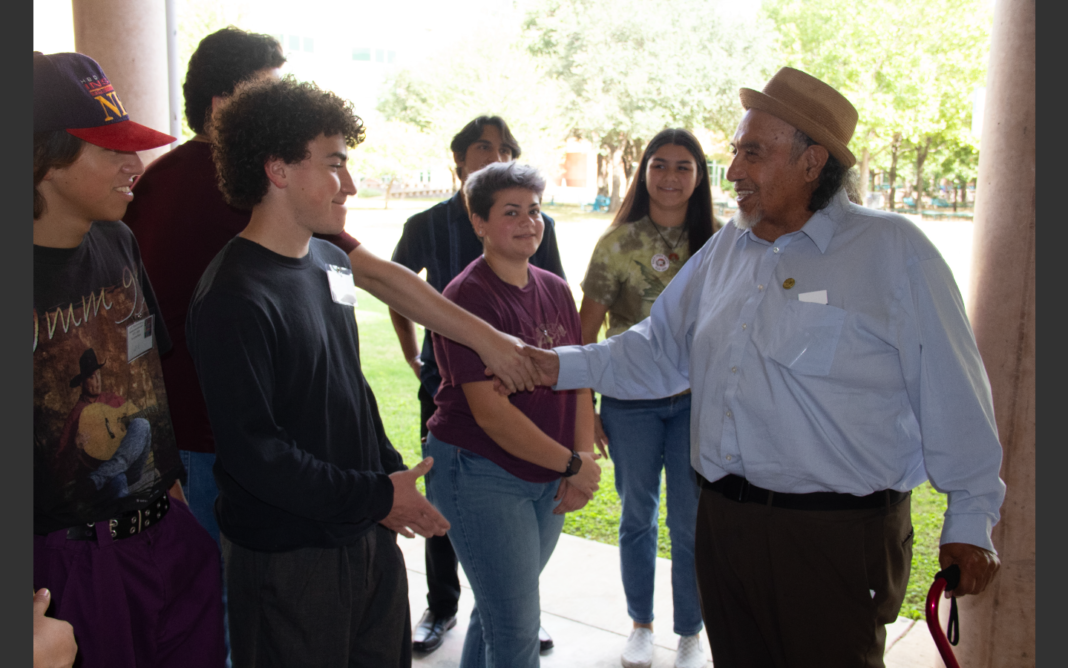

Remembering “Leno”
I met Leno through his poem, “I Am the Bad Hombre” published in the Border Angels Newsletter from San Diego. I was deeply impressed with his connection and understanding of “Los de ‘abajo”. How can he not be, when he was representative of his people? He was speaking for the same people the Tribuno represented.
When I asked permission to publish his poem in el Tribuno del Pueblo, Leno was humbled and graciously gave us permission to publish it. There began a beautiful revolutionary amistad, and many articles followed.
When Tribuno del Pueblo and People’s Tribune made a call to take action on the violations of human rights at the Southern Border, he was the first to respond to the call.
In 2019 I finally met Leno in San Diego, California at the offices of the American Friends Service Committee (AFSC). The arrival of migrant caravans at the border had created a tense situation, and a few of us–Gloria M. Sandoval and Salvador Sandoval from Journey for Justice from the San Joaquin Valley, Magadaleno Rose-Avila from Building Bridges, Pedro Rios from AFSC and myself representing the Tribuno del Pueblo/People’s Tribune, decided to meet in person to discuss how to support border communities.
We decided to organize a caravan that would visit border communities to talk and interview community leaders. Unfortunately, COVID happened and we moved to hosting webinars. Hector Barajas of Undocumented Veterans and Leno coined our name, Zooming to the Border for Human Rights Coalition, which after the pandemic became Zooming to the Resistance.
From mid-August to mid-October 2020 we held a series of People-to-People Fact-Finding Panels on the U.S.– Mexico Border, which Leno was key in organizing. The topics covered included the impact of the Migrant Protection Protocols, the conditions facing workers in the El Paso/Cd. Juarez region, how border wall construction hurts local communities and ecosystems, the experience of those working for human rights on both sides of the border in the Mexicali, Tijuana and San Diego areas, and the militarization of border communities. Testimonies gathered from the panels were compiled into a report presented to the United Nations and other authorities.
Fast forward seven years later and Leno helped organize our most recent webinar on May 14, “A Review of the Expanding and Unaccountable Powers of the US Immigration Enforcement System”, just a week before he passed away. He was probably not feeling well but he regularly tried to make the planning meetings, no matter what. That was Leno.
Leno was an avid writer and wrote about the ills of society and put forth humane solutions.
Leno, our friend, you will be missed. But we will follow your example of standing and uplifting the human rights of all.
Leno, ¡Presente!
I AM THE BAD HOMBRE
First published May 6, 2019
I am THE BAD HOMBRE
Yep .. ya probably saw me
Sometimes …
Harvesting something that soon would be on your dinner table
Something fresh and beautiful for you
And your family …
I am the Bad Hombre
Who struggles to live
A decent life
While others call us names
Tainted by racism and fear
Making me out to be a monster
That I am not…
I want nothing more than a reasonable chance
To believe in the moon
And dance with the wind
To build a world of peace and love
For any every one
Under the sun …
https://archives.tribunodelpueblo.org/2019/05/i-am-the-bad-hombre/
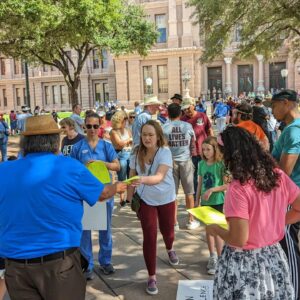
Magdaleno “Leno” Rose-Avila Eulogy
We celebrate the life of Magdaleno “Leno” Rose-Avila — a father, partner, brother, mentor, poet, organizer, advocate, and friend whose life was defined by love in action.
Leno passed away on May 7th, 2026, after a many-weeks-long closing chapter to a life extraordinarily well lived in pursuit of justice, dignity, and human rights for all people. Though we mourn his loss deeply, we also stand together in gratitude for the remarkable gift of having known him, loved him, learned from him, and witnessed the impact of his life.
To speak about Leno is to speak about movement. Movement across borders. Across communities. Across struggles. Across generations. He never stayed still for long because there was always another person to help, another injustice to confront, another voice to uplift, another dream worth fighting for.
Leno was born on September 7th, 1945, in Las Animas, Colorado, to Marcos Trinidad Avila and Carmen Montes Avila. He was the sixth of twelve children and the first son in a hardworking immigrant family from Mexico. The family lived and worked in a colonia on the Spady Farm, where life was not easy, but where values of sacrifice, humility, faith, resilience, and love were deeply rooted.
His nine sisters and two brothers helped shape the man he would become. He carried with him the lessons learned in the onion fields of southeast Colorado, where he began working beside his father at just eleven years old. Those early experiences exposed him to hardship and inequality, but they also ignited something powerful within him: a lifelong commitment to standing with working people and those too often pushed to the margins of society.
That commitment became the mission of his life.
In 1970, he helped organize all-female lettuce pickers and packers to walk off the fields in protest for dignity and fair treatment. He later led a 120-mile march from Pueblo to Denver to shine a light on the struggles of farm workers. By the time the march reached the state capitol, thousands stood waiting in solidarity. Even then, people could already see what the world would come to know about Leno: he had the rare ability to make people believe that change was possible.
Throughout his life, Leno dedicated himself to some of the most urgent human rights causes of our time. He worked alongside civil rights leaders including Coretta Scott King, Reverend Joseph Lowery, Sister Helen Prejean, and his dear friend Dolores Huerta. Yet despite the extraordinary people he encountered, Leno never cared about status or remuneration. What mattered to him were people. Human beings. Especially those whom society overlooked, rejected, criminalized, feared, or forgot.
He saw humanity where others refused to look.
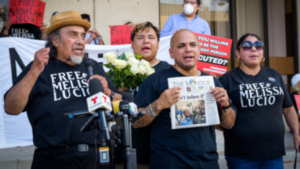
Photo / Death Penalty Action
He served as a United Farm Workers Union organizer, worked with Amnesty International USA leading anti-death penalty efforts, and fought tirelessly against death penalty executions and systemic injustice. He worked with Witness to Innocence and Death Penalty Focus because he believed every human life held value, even when the world had given up on people.
As Leno’s movement for justice and human rights grew across communities and countries, his family remained committed supporters and participants in his life of activism.
In 1976, he met his lifelong supporter and often co-conspirator, Carolyn Rose. They married in 1978 and, in a reflection of their shared progressive values, they combined their last names into “Rose-Avila,” a meaningful and uncommon decision at the time that reflected partnership and equality.
Following his post as Peace Corps Director in Nicaragua in 1978, Magdaleno and Carolyn relocated to Guatemala as Co-Directors, bringing with them Kimbo Tenorio, the son of one of Leno’s former partners, whom he adopted as his son, along with Leno’s younger brother, Michael Avila, to live together as a family while he continued his work with the poor and disenfranchised.
Leno, always restless to make a difference, left Peace Corps Guatemala in the hands of Carolyn, to run the U.S. congressional campaign for then-Colorado State Senator Polly Baca Barragan. The family then moved to Washington, D.C. in 1981 for Leno to work at the Democratic National Committee. Itching to make change happen, he went on to run a U.S. senatorial campaign for Nancy Dick, then Lieutenant Governor of Colorado. In 1985, Leno and Carolyn welcomed into the world their daughter, Aviva Rose-Avila.
He then moved the family to Atlanta Georgia, where he became the Southern Regional Director of Amnesty International, followed by Director of Amnesty’s Campaign to Abolish the Death Penalty in New York City. In 1988, he worked with then-Executive Director Jack Healey to carry out the groundbreaking Amnesty benefit concert, Human Rights Now! — a worldwide tour that crossed 15 countries in commemoration of the 40th anniversary of the Universal Declaration of Human Rights. Headliners included Bruce Springsteen, Tracy Chapman, Sting, Peter Gabriel, and Youssou N’Dour. Following New York, Leno and the family moved to Altadena, California, for him to become the Western Regional Director of Amnesty International.
While in Southern California, he built a lifelong bond with Sister Helen Prejean and joined her on her 12-day promotional tour for her book, Dead Man Walking. Due to their deep friendship, he later appeared briefly in the film adaptation of Sister Helen’s book by Tim Robbins, also titled “Dead Man Walking”. He was quite proud to appear in a brief scene with his heartthrob, Susan Sarandon.
Following the death of Cesar Chavez of the United Farm Workers Union in 1993, Leno was invited to serve as the first executive director of the Cesar Chavez Foundation, moving to the union headquarters in La Paz, California. He then moved with his wife, Carolyn, who had taken a position with Save the Children, and his daughter to El Salvador. In a chance meeting while representing Save the Children, he met recently deported gang members, which eventually grew into a partnership to create Homies Unidos/El Salvador to help end youth gang violence and create pathways toward healing and hope for young people trapped in cycles of poverty, violence, and trauma.
Leno invested his own resources, together with those of Save the Children/Norway, to produce the first study of gang life in El Salvador, carried out jointly by opposing gang members, Mara Salvatrucha and Calle 18. Homies Unidos became a lifelong passion for Leno, convincing Alexander Sanchez, a former gang member, to become the first and now recognized Executive Director of Homies Unidos/Los Angeles. For Leno, compassion was never theoretical. It required action. Sacrifice. Presence.
Leno’s work also extended globally with the U.S. Peace Corps, where he served as Country Director in four countries: Nicaragua in 1978, Guatemala in 1979, Paraguay in 2000, and Micronesia in 2001. In every country, every city, and every community, he built relationships rooted not in power, but in solidarity and respect.
In Seattle, Leno became a beloved and transformational leader. As Executive Director of the Northwest Immigrant Rights Project (NWIRP) in 2003, followed by Director of the Social Justice Fund NW, and later as the first Director of the Seattle OVice of Immigrant and Refugee AVairs under Mayor Michael McGinn from 2010 to 2014, he helped shape systems that welcomed immigrants and refugees with dignity. In 2006, the City of Seattle honored him with its Distinguished Citizen Award for Human Rights — a fitting recognition for someone who dedicated his life to making others feel seen, protected, and valued.
Once leaving Seattle, Washington, he moved to Ashland, Oregon, in 2014 to join the successful campaign to abolish GMOs in Jackson County with Our Family Farms, which defends Jackson County’s GMO-Free Seed Sanctuary.
Throughout his varied career intertwined with activism, he never ceased advocating for the abolition of the death penalty. He became the Director of Witness to Innocence in 2015, an anti-death penalty organization founded by Sister Helen Prejean and directed by a board of directors composed of individuals wrongfully accused and exonerated from death row.
He became a founding advisory committee member of Death Penalty Action in 2017 and went on to become the Executive Director of Death Penalty Focus in California in 2018. Throughout these years, he was also a committed activist with Journey of Hope.
Throughout his life, he wrote both stories and poetry. Publishing a book of short stories and poems called Looking for My Wings. Over his last six years, he wrote regularly and feverishly for a Latino community paper in Philadelphia named Impacto de La Esperanza, edited by Perla Lara. He published more than 300 articles with his final articles focusing on Bad Bunny and his NFL halftime performance. He believed Bad Bunny’s performance represented a tipping point, defining the Americas as far larger and more diverse than the United States and characterized by a potpourri of cultures and languages that unite us through diversity. He also wrote for El Tribuno del Pueblo, led by Laura Cortez Garcia out of Chicago, Illinois.
Even nearing the final years of his life, he never stopped serving. While many would have chosen rest, with the support of Carolyn, Leno moved to Magdalena de Kino, Sonora Mexico, just below Arizona, and continued working in communities along the U.S.-Mexico border, helping asylum seekers and deported immigrants find support, food, dignity, and hope. In recent years, he became recognized for the natural soap products he distributed to shelters from Tijuana to Nogales. He became close with David Bronner, President and CEO of Dr. Bronner’s Magic Soap Company, and Carleen Pickard the then Director of Advocacy and Activism for Lush Fresh Handmade Cosmetics North America. Both companies generously donated boxes of natural soap products that he tirelessly distributed and gifted along with his signature Frida Kahlo aprons.
But titles and awards only tell part of the story.
What truly made Leno extraordinary was who he was in everyday moments. People remember his laughter before they remember his résumé.
They remember his stories, his humor, his poetry, his warmth, and his ability to walk into any context and make people feel like family. Friends describe him as someone who was “always doing a million things,” yet somehow still had time to listen deeply, encourage generously, and connect personally.
He had a gift for making people feel they mattered.
He mentored organizers, young activists, immigrants, students, faith leaders, and community members across generations. He opened doors for others. He shared his knowledge freely. He believed movements were built not only through speeches and strategy, but through relationships and love.
This was Leno. Even when joining church services at Bethany UCC Church in Seattle via Zoom from wherever he happened to be, his answer to “Where are you now?” was almost always the same: he was wherever people needed him most.
Always showing up.
Always believing people deserve better.
Always believing we could build something more just, more compassionate, and more humane together.
And perhaps what is most remarkable is that after decades of struggle, disappointment, setbacks, and witnessing injustice firsthand, he never became cynical. He never lost faith in humanity. He never lost his sense of humor. To the very end, he believed in the power of collective action and human connection.
The day before he passed, he reportedly repeated the words: “We will win. We will win.”
Leno understood that justice is never an individual pursuit. It belongs to communities; to movements; to people willing to stand beside one another across race, class, nationality, and circumstance.
Today, we honor not only what he accomplished, but how he lived.
He taught us that courage can be compassionate.
That leadership can be humble.
That activism must be rooted in love.
That humor belongs even in struggle.
That no human being is disposable.
And that a meaningful life is not measured by wealth or status, but by how many people are safer, stronger, and more hopeful because you existed.
Leno leaves behind an extraordinary legacy carried forward by his oft-instigator and motivator, Carolyn Rose-Avila; his daughter, Aviva Rose-Avila; his son, Kimbo Tenorio; his siblings; extended family; countless friends, colleagues, mentees, and communities around the world.
But perhaps his truest legacy lives in the people he changed.
The organizers he inspired;
The immigrants he defended;
The young people he believed in;
The prisoners he advocated for;
The farm workers he marched beside;
And the communities he mobilized.
The friends he loved.
The family he cherished.
And all of us gathered here today.
There is a quote often attributed to Dr. Martin Luther King Jr.: “Life’s most persistent and urgent question is: What are you doing for others?”
Leno answered that question every single day of his life.
And now it becomes our responsibility to carry that spirit forward.
To continue opening doors.
To continue fighting injustice.
To continue seeing humanity in one another.
To continue believing, as he did, that another world is possible.
Magdaleno “Leno” Rose-Avila lived a life of extraordinary purpose, profound compassion, and relentless hope.
May we honor him not only with our grief today, but with our actions tomorrow.
And may we continue the work he dedicated his life to with the same courage, humor, generosity, and love that defined him so beautifully.
Rest in power, Leno.
We will win.
Tribuno del Pueblo brings you articles written by individuals or organizations, along with our own reporting. Bylined articles reflect the views of the authors. Unsigned articles reflect the views of the editorial board. Please credit the source when sharing: tribunodelpueblo.org. We’re all volunteers, no paid staff. Please donate at http://tribunodelpueblo.org to keep bringing you the voices of the movement because no human being is illegal.