

Editor’s Note: The following article was originally published by Cynthia Griffith from Invisible People on August 31, 2026.
As rents and income requirements outpace wages, a growing number of working Americans, including full-time employees and small business owners, are being pushed to live in their cars, even as the number of people who can afford a car at all is shrinking.
Vehicular Homelessness Is Rising as Housing Prices People Out Entirely
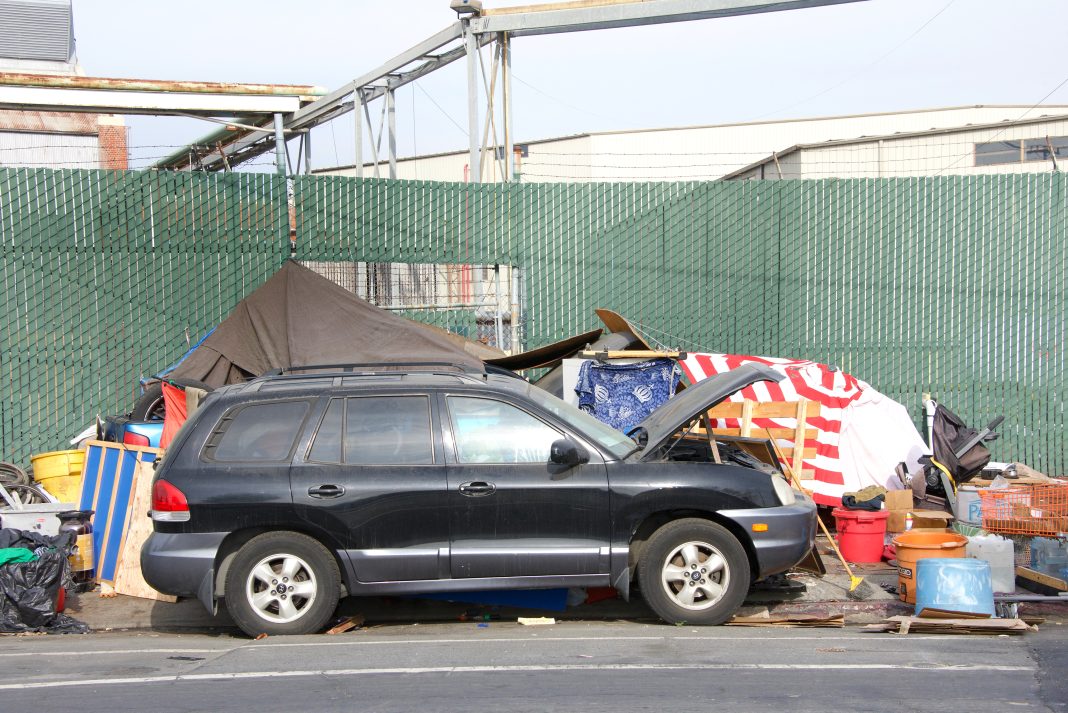
As the US faces its lowest moment in new car purchases, more people are planning to live in their vehicles with their families. Here, we see something that was once a status symbol of upward mobility becoming the final barrier between stable housing and sleeping on a street corner.
This phenomenon is emblematic of an unprecedented lifestyle shift — one where the American dream appears to have gone from buying a car to living in one.
Vehicular homelessness is on the rise, particularly in places like California where the cost of living is exceptionally high. For example, San Francisco exhibited a 37% increase in vehicular homelessness between 2022 and 2024, reflecting approximately 1,444 new cases in just two years.
Meanwhile, an estimated 50% of LA’s homeless population relies on cars for microshelter, and there are currently 6,231 individuals or families presumed to be using their vehicles as temporary dwelling spaces in that section of California right now. This translates to roughly:
- 1705 cars
- 2796 RVs
- 1730 vans
Between the decrease in car sales and the increase in people using their vehicles as makeshift shelter, a harsh reality is clear. In an exclusive exchange with Invisible People reporters, Emil Aghakian, Executive Director of Homeless Services with Elmira Recuperative Care, affiliated with Northstar Health Systems and operating 3 homeless shelters in SoCal, explained:
“Housing has just become too expensive for a lot of people. Years ago, having a car was a sign that you were doing well and moving forward. Now, for some people, that same car is the only place they can afford to sleep,” said Aghakian. “We see people who are working, getting benefits and genuinely trying to get back on their feet, but they still can’t afford rent. And sometimes it doesn’t take much — a job loss, a medical issue or falling behind on a couple of bills can put someone in that situation. We see it every day at our facility.”
“I think that’s the part people don’t always realize,” added Aghakian. “A lot of people living in their cars aren’t that far removed from having a home. Their car is basically the last thing they have before ending up on the street.”
The Unexpected Intersection Between Declining Auto Sales and Vehicular Homelessness
As Aghakian rightly pointed out, a car can serve as a barrier, a last resort between housing and having to live outside on the actual street. For this reason, the sudden decline in new car sales is especially concerning. It raises a deeper question we have to eventually ask: How long before people can no longer afford to live even in cars anymore?
CNBC reports we could see nearly 2 million fewer new car sales by 2040. That number disproportionately impacts young people who are increasingly accounting for larger portions of the invisible or hidden homeless population.
Online accounts document this harsh reality in real time, as single mothers, underemployed teachers, everyday laborers, and senior citizens speak about “going homeless” as if it were a new survival strategy.
“I make almost twice the minimum wage, and I’m still thousands of dollars below the poverty line,” said one YouTuber enduring vehicular homelessness in an eye-opening documentary entitled “Americans living in their cars.”
Another interviewee showed the digital audience what it was like to bundle up in preparation for a brutally cold night’s sleep behind the steering wheel. Driver’s seats reclined. Trunks were doubled into beds.
A 78-year-old woman described what life was like hanging by a thread.
A middle-aged man detailed the unfathomable hunger pains he’s endured while slumbering in his vehicle each night.
Roughly 1 million US residents now claim their vehicle is their primary residence. At the center of all of these stories was one central thread — humanity. These are people like you and me, and they are barely able to survive.
Buckle Up: There’s a Rough Road Ahead
As the housing supply continues to lag behind demand, landlords are in an authoritative position to raise more than just rents. They have also raised salary requirements.
According to Zillow’s research team, “Renters Need to Earn $100K in Twice as Many Markets as in 2020.”
Furthermore, post-2020 data reflects a 34.9% nationwide increase in the required renter’s salary rates. This means that in real-life situations, renters need to make roughly $20,949 more per year than they did six years ago.
Meanwhile, median incomes across the United States have risen only marginally, by about $2,150 annuallywhen adjusted for inflation. This poses a serious dilemma and one that California resident and small business owner Gina Jet Ortiz is all too familiar with.
Ortiz operates a SoCal-based makeup and photo business. She recently told Invisible People reporters that even with a stable income and sizable savings, she was rejected for housing because her tax returns did not reflect the income threshold for the area where she lives and works.
“I’m a college-educated small business owner, and I became homeless not as a result of affordability or availability of housing, but because of the ridiculous income requirements,” said Ortiz. “If the average apartment in Los Angeles costs $2,200-$2,500 per month, then a renter must prove via tax returns that they earn $6,600-$7,500 per month. In other words, if a renter does not earn between $79,000 and $90,000 per year, they will be denied housing.”
“I was forced to live in my car when my funds ran out, since I could not qualify for even a lousy apartment in a bad neighborhood,” Ortiz continued. “I had over $10,000 in savings that I ended up wasting on motels while I applied for apartments. The income requirement was non-negotiable, and I blew through my savings in a couple of months.”
Navigating Vehicular Homelessness: Is There an Off Ramp?
To further understand the conundrum posed by the unprecedented decline in new car sales and the recent rise in vehicular homelessness, particularly on the West Coast, we turned to Becks Heyhoe-Khalil, the executive director of United to End Homelessness. Her organization is based out of Orange County, California.
“In our 2026 Point-in-Time Count, we saw the same data trends as we saw in 2024 and 2022, around people’s last, permanent address before falling into homelessness,” said Becks. “And that has always been around the 76% mark in Orange County.”
“What we know is that people were housed in our community and then, unfortunately, they lost that permanent housing,” she continued. “These are our neighbors. These are our friends and community members, and one piece that was new to our PIT count, but not new data to our community, is connected to the causes of homelessness: the factors that led to people losing their housing.”
“Our recent point-in-time count actually posed this question for the first time,” Becks said. “52% of the people asked cited financial factors as the chief reason they became homeless. This is the number one reason. For many people, the first place that they go to is living in their vehicle, because it offers a level of safety for them.”
Tell Your Legislators We Need Permanent Affordable Housing
As Ortiz explains, the solution to homelessness is always affordable housing:
“If the government were truly interested in “solving” homelessness, a good place to start would be to stop allowing private equity firms to buy up all the housing and demand a large chunk of the workforce to earn $90,000 per year to live there!”
Future car purchasing power could depend heavily on lowering housing prices and rental rates. Common sense denotes that as housing prices increase, car purchasing power sharply declines. This would be true even if new car prices remained stagnant. However, the price of a new vehicle has also gone up, crippling everyone and taking an especially heavy toll on young people, senior citizens, and low-income earners.
In this market, car repossessions have risen, and vehicle ownership has plummeted. If, for most people, the thin barrier between street homelessness and housing is residing in a vehicle, what happens when this upcoming generation, which already has a statistically lower vehicle ownership status, faces housing instability?
Affordable permanent housing is the only off-ramp out of this situation. Please steer your local legislators in that direction today.
Tribuno del Pueblo brings you articles written by individuals or organizations, along with our own reporting. Bylined articles reflect the views of the authors. Unsigned articles reflect the views of the editorial board. Please credit the source when sharing: tribunodelpueblo.org. We’re all volunteers, no paid staff. Please donate at http://tribunodelpueblo.org to keep bringing you the voices of the movement because no human being is illegal.