
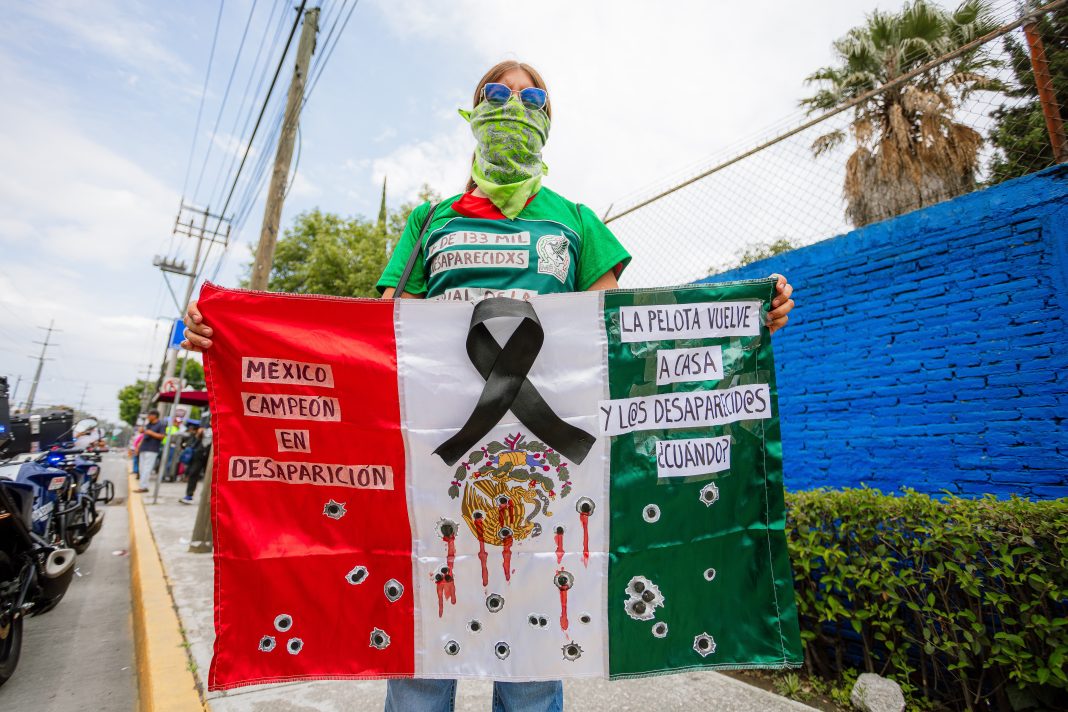

Editor’s Note: The following article was written by Natasha Last-Bernal, one of the Tribuno’s 2026 Summer Interns. Since the Mexican National Team was eliminated from the 2026 Fifa World Cup on July 5th, protests have dwindled but the numbers of disappeared Mexican nationals, including journalists, continues to rise. While media attention has turned away from Mexico City, Mexican citizens continue to demand the government acknowledge and properly investigate the disappearances of so many citizens.
Hours before the opening ceremony of the 2026 FIFA World Cup, more than 400 relatives of Mexico’s disappeared marched down Calzada de Tlalpan toward Mexico City Stadium with a sobering indictment. Holding candles, photographs of missing loved ones, and Mexican national team jerseys modified to bear their faces, the families delivered a message aimed at a government they say has mobilized more effectively for soccer than for the country’s missing:
“La pelota vuelve a casa… ¿Y tú cuándo? – “The ball is coming home… but when are you coming home?”
The march on June 10, called Iluminemos la búsqueda, or Let’s Light Up the Search, drew protestors from at least ten Mexican states. The movement was driven by the Madres Buscadoras, grassroots collectives of mothers searching for their disappeared loved ones, who had traveled to the capital for the candlelit vigil and march down one of the nation’s busiest avenues. Participants set up altars decorated with marigolds, placed missing-person fliers, and held a small “anti-World Cup casarita” or pickup soccer game, aiming to redirect public attention to the over 133,000 people currently missing in Mexico.
“They cannot cover the sun with one finger by bringing a World Cup when there is no budget for the search of our loved ones,” Tranquilina Hernández, mother of Mireya Montiel Hernández, missing since 2014, told Agencia EFE before the match.
Yet the march never reached its destination. The families held their vigil against an intimidating backdrop; police fences, buses, and security officers from Mexico City’s Public Safety Secretariat blocked the road forward, forming a perimeter around the stadium. Footage circulated on social media showed an elderly woman kneeling before police officers, pleading to be allowed through the barricade. Some reportedly attempted to climb over the barriers as chants of government repression rose through the street.
Hernández defended the desperation, telling EFE, “I think we are fully within our rights to release all our frustration, so much pain, and so much anguish.”
For many, the confrontation reflected years of frustration with a crisis that has continued despite government promises of action. The vast majority of the disappeared have vanished over the last two decades, tied to the surge in cartel violence that accompanied the militarized “war on drugs” under former President Felipe Calderón in the early 2000s. Search collectives say many disappearances are linked to forced cartel recruitment or retaliation against those who resist. After the horrific discovery of hundreds of personal belongings and three cremation sites at a cartel-operated ranch in Jalisco in March 2025, President Claudia Sheinbaum proposed reforms to expand disappearance investigations, national alert systems, and identification mechanisms, declaring the problem a national priority.
However, the crisis persists. According to the National Registry of Disappeared and Unlocated Persons, the number of unidentified remains in Mexico has grown from 52,000 in 2021 to approximately 72,000 by 2026. Prior to the opening, search collectives denounced personnel at Mexico City Stadium for allegedly removing memorial cards of disappeared relatives, “our photo flyers were not political propaganda, they were not commercial advertisements, they were not vandalism. They were faces. They were names. They were missing sons, daughters, brothers, sisters and fathers,” they stated.
Sheinbaum herself has faced criticism as activists say the country prioritized its public image on the eve of the World Cup. “Instead of dismissing and minimizing, the President should ask herself why we continue to take to the streets if her team assures us that she is addressing the problem,” one search collective wrote, insisting that protests are not aimed at disrupting the event. Rather, they are aimed at raising awareness and shedding light on government inaction.
Activists argue the state withholds resources and capacity to help, but can quickly mobilize to deploy officers, secure stadium roads, manage public image, and protect tourists visiting for the historic event.
“Today the State shows us that it does have the police to find the disappeared, but decides to protect foreigners,” Buscadora Jaqueline Palmeros said through a megaphone, according to EFE.
Madres Buscadoras have faced pushback from authorities and soccer fans alike. Yet the demonstrations continued throughout the tournament. On June 30, families of the disappeared again gathered outside Mexico City’s stadium ahead of the Mexico–Ecuador match, chanting, “FIFA, your cup stands over a grave.” Witnesses filmed heated confrontations with security personnel, underscoring the mothers’ determination to use the World Cup’s global spotlight to draw attention to the disappearance crisis.
“We do not intend to ruin your party, on the contrary, we hope you can enjoy the games; our loved ones also liked soccer and today they are not here to witness the cup,” said a mother, anticipating the backlash.
As thousands celebrated Mexico’s World Cup matches in the capital, the fate of thousands more remains unknown. More than 133,000 remain missing across Mexico. In states such as Jalisco, Tamaulipas, and Guanajuato, their family members – overwhelmingly their mothers – will continue organizing search parties, coordinating advocacy campaigns, and digging through fields and ranches in search of overdue answers.
Tribuno del Pueblo brings you articles written by individuals or organizations, along with our own reporting. Bylined articles reflect the views of the authors. Unsigned articles reflect the views of the editorial board. Please credit the source when sharing: tribunodelpueblo.org. We’re all volunteers, no paid staff. Please donate at http://tribunodelpueblo.org to keep bringing you the voices of the movement because no human being is illegal.